Tuesday, November 23, 2021

Drug Discovery Prologue (Dunning Kruger Saga Part 2)


Drug discovery is awfully slow, expensive and prone to high failure rates.

About 96% of drugs being developed will fail. Some researchers have estimated that the current probability of success is not much better than a random approach.  

The average cost of bringing a drug to commercialization is estimated to be between $1b to $2.6b. This cost figure includes cost expended on the many failures. Over the last 7 years, the average costs have risen by over 100%. At current trends, within 20 years, the average cost per drug to commercialization will balloon to over $20b.

The average time to bring a drug from discovery to market ranges between 10 to 15 years.

In 2019, the pharmaceutical industry spent $83 billion dollars on R&D. This figure is likely to be much higher in the wake of COVID19. Adjusted for inflation, this is about 10 times what the industry spent per year in the 1980s. For the industry as a whole, over ten years from 2010 to 2019, Deloitte’s estimated the returns on R & D has fallen from 10% to 1.9%. In 2020, the return increased slightly to 2.5%.

The major causes of failure in drug discovery come from a combination of efficacy and side effects. Other significant factors include commercial factors and avoidable errors such as bad trial designs and non-compliance with regulatory requirements.

This is a problem that is in desperate need of a solution. The size of the pharmaceutical industry is estimated to be about USD$1.5t in 2020, and this is projected to grow at about 7% CAGR for the next 8 years.

The next blog post will examine the fundamental reasons for the dismal outcomes in drug discovery. Then we will take a stab at the possible solution providers.

Yours One Legged

Thursday, November 18, 2021

Biotech Investing- A Failed Approach (Dunning Kruger Saga- Part 1)


A lesson from my recent pivot into the lifesciences and healthcare field is an old familiar one. 

The first area I explored is the field of drug discovery. More particularly, single product narrow focus drug discoverers. It is the equivalent of looking at mineral explorers listed on the ASX. The main rationale for this approach is that drugs are important drivers of  the entire industry. I need to first understand the drugs and treatments in order to understand the ecosystem.

Being a numbers person, naturally I started looking at the various published studies on the historical success rates of various drugs in different areas eg oncology, vaccines, infectious diseases, etc. The supposition is that if I know the probabilities of success, I may be able to put bets on expected positive outcomes. I could then size the positions based on the Kelly Criterion and run a portfolio on this basis.

For example, say the base historical success rate of oncology is 3%. If the total addressable market for a particular drug in development is over $1b, we can estimate that if the drug achieves commercial success, the market cap of the company should be well over $5b. Given a 3% success rate, the entry price for a positive expectancy must be below $150m (assuming no dilution).

Let’s say we can get an entry at $100m. At 3% probability of success based on being undiluted (an unrealistic assumption already), but with a potential 50 bagger, we have a positive expected outcome. The Kelly Criterion based on this number says we should risk 1% of the portfolio. A more practical half Kelly stance puts us on 50 basis points.

Let’s now say we can find 200 positions at 50 basis points to fill out our entire portfolio. What can possibly go wrong?

We have just made an assumption of independence of outcomes between all the bets. In other words, we are assuming all of them are separate throws of dice with each outcome not influencing one another. Biology does not work that way, so drugs seldom work (or don’t work) that way too. Developments with one drug candidate can have significant influence on many other drug candidates in adjacent areas. When the debris has settled, I might just find that 20% of my portfolio has been wiped out because they are in essence all connected in some way. It could be a particular biological pathway, it could be a mechanism of action, it could be a flawed delivery mechanism, it could be a previously undiscovered genetic problem, it could be a downstream side effect, it could really be anything if I just did not know where to look.

More importantly, my competitors will usually have an army of 15 or more PhDs in various areas of medicine and science, and they collectively have over 300 years of experience. They have expert networks and resources from which to draw upon. They are paid very well to monitor a much larger pool of drug candidates in development, way bigger than my pool of 200 that I will struggle to just keep up with.  And I bet you they knew where to look well in advance.

This is one contest I want to avoid.

Let me know your thoughts in comments below.

Yours One-Legged.

Monday, June 22, 2020

Good Articles I Read Recently

Morgan Housel on Things That Will Never Change- here.

Morgan Housel on why tail end events are all that matters- here.

Li Lu- on the practice of value investing, the role we play as capital allocators, and why speculation is a zero sum game- here.

Enjoy and Prosper (but keep your distance),
Yours One-Legged

Sunday, December 22, 2019

Merry Xmas and a Happy New Year

Well folks, we are closing in on another year.

I will be taking a short break for about 5 weeks.

Please have a safe and merry Xmas and a very Happy New Year!

Yours One-Legged

Wednesday, November 13, 2019

Account Recovered!

Folks, sorry for the absence.

To cut a long story short, I lost my password to this account.

I have managed to somehow recover and reset the password.

So yes, we are back!

Stay tune for further posts.

Tuesday, September 4, 2018

Podcast with the Strawman and Book Reco

Podcast Link


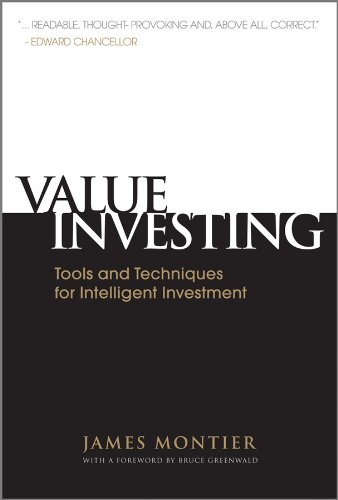
I think it might be remiss of me not to mention this book:

Value Investing: Tools and Techniques for Intelligent Investment by [Montier, James]

https://www.amazon.com/Value-Investing-Techniques-Intelligent-Investment-ebook/dp/B0030CHFBM/ref=tmm_kin_swatch_0?_encoding=UTF8&qid=&sr=

Montier talks about the trinity of risks:

1. Valuation Risk
2. Earnings Risk
3. Balance Sheet Risk

Ultimately, the main idea is that risk is not a number, it is a notion/concept. Confusion sets in when we fail to separate price from value. I have harped on enough about this already. If it is not obvious now, it will never be.

Friday, May 11, 2018

Friday Musings

What is the market? Is it a thing or a process? Or both- much like particle/wave duality in physics?

This has something to do with market efficiency and edge.

I will try to fill in more later. Just bookmarking random thoughts.

Friday, May 4, 2018

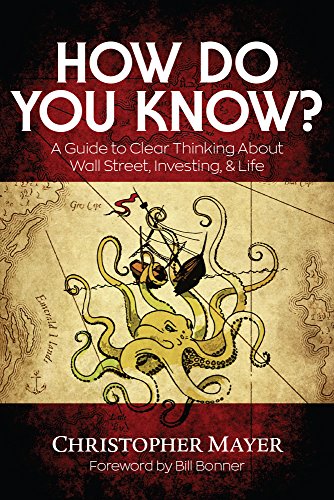
Book Review: How Do You Know?

How Do You Know?: A Guide to Clear Thinking About Wall Street, Investing & Life by [Mayer, Christopher W.]

Link to Amazon

One of the four principles of value investing espoused by Li Lu (link here) is to understand and identify one's circle of competence. To do that, the first basic questions are likely to be What Do I Know? and How Do I Know?

This is where Chris Mayer's book comes in handy.

This is not a spoiler. The basic premise in Chris' book is that we don't really know much at all.

Realising that we don't really know much at all (actually being convinced and internalising this reality, instead of paying lip service to it) could actually be the dawn of real wisdom.

For me personally, this book has helped me reconcile conflicts and issues in respect of religions (short answer: degrees of belief, reasonably based) which is just a short hop away from issues in investments (short answer: degrees of conviction, reasonably based).

The need for a margin of safety in investments is brought into stark relief when one considers the vexed issue of cause and effect. A background knowledge and reading of Nicholas Taleb's books would assist the reader here.

I have previously caused some controversies in a previous book review. It is not my intention to cause offense again to honest and good work done by others. I do this in the spirit of intellectual inquiry for the betterment of all involved, and I hope my following comments will be interpreted as such.

The pitfalls of data mining and survivorship bias are clearly demonstrated in Chris Mayer's book (Chapter 2) where he wrote about subsequent studies on the "great" companies covered by the authors of bestsellers In Search of Excellence (Peters and Waterman) and Good to Great (Collins and Porras).

The efforts of the authors of Intelligent Fanatics should be read in conjunction with the above and also with this excellent article from the Scientific American published recently in March 2018. A very basic summary of some tentative scientific research shows that whilst talent is important, luck plays a large role in success.

Enjoy and Prosper,
Yours One-Legged


Sunday, April 22, 2018

Peter Kaufman's brilliantly instructive speech

Here is the link.

If you really want to learn, it helps to stand on the shoulders of giants. Please enjoy the view.

After you have finished, readers may want to have a go at formulating further models from Kaufman's three buckets, and if possible, a practical application for each model. You do not need to limit yourself to applications in the investing world.

Enjoy and prosper
Yours One Legged

Thursday, April 5, 2018

A Possibly Useful Heuristic to Avoid Losing Money

I watch with bemusement in recent days the stoush between Glaucus and Blue Sky Investments (BLA). The nosebleedingly high valuation which BLA managed to achieve before Glaucus came out firing could possibly be attributed to investors' thinking that BLA could be the next Magellan.

Indeed, Glaucus has labelled BLA as the Brisbane-based wannabe KKR.

I do not have a beef in this stoush, and frankly, I do not know enough to make a judgment.

But I do adhere to a useful heuristic. I stay away from companies that tout themselves as the "Next XYZ".  The next Microsoft, the next Google, the next CSL, the next Berkshire, the next Ebay, you have probably heard them all. Where are they now?

Each successful company is a byproduct of its surrounding circumstances. The combination of circumstances that gave rise to a very successful company is always unique. And it is this exact uniqueness which accounts for its success. To replicate the company would required replication of both its internal composition AND its surrounding circumstances. How likely is that to happen?

Furthermore, what does it tell you of the ethos, drive, or culture of a company which is merely content to be the next XYZ? Are you likely to find a hungry owner-operator with a vision beyond just mere filthy-lucre?

Something to think about as our weekend approaches. Comments welcomed.

Yours One Legged


Sunday, March 25, 2018

Giverny Capital Annual Letter 2017

Here is the link to Giverny Capital Annual Letter 2017.

In my humble opinion, this is one of their best, if not THE BEST, letter to date.

A tremendous performance from a truly gifted team.

As imitation is the sincerest form of flattery, you will see much cloning in all of my correspondence and posts from henceforth, if not already.

Monday, February 26, 2018

Excerpt from transcript of CNBC Buffett interview Feb 2018

BECKY QUICK: I mean, you lay this out in the annual report, but a lot of investors are told – retail investors are told, that they should have a certain percent of their portfolio in bonds. Maybe they're told 60/40, maybe they're told 70/30 stocks to bonds. That's something that you should do and that's the safe way of doing. What are they missing?
WARREN BUFFETT: Well, some people should not own stocks at all because they just get too upset with price fluctuations. If you're going to do dumb things because a stock goes down, you shouldn't own a stock at all. No, I mean—
BECKY QUICK: What are dumb things? Selling a stock because it goes down?
WARREN BUFFETT: Yeah, selling a stock because it goes down. I mean, you know, if you buy your house at $20,000 and somebody comes along the next day and says, "I'll pay you $15,000," you don't sell it because the quote's $15,000. You look at the house or whatever it may be. But some people are not actually emotionally or psychologically fit to own stocks. But I think more of them would be if you get educated on what you're really buying, which is part of a business. And the longer you hold stocks, the less risky they become, whereas the longer the maturity of a bond, the more risky it becomes.
BECKY QUICK: Do you feel like that's a message that is getting through to people? It's one that you repeat again and again. And I always feel like, I was watching a lot of the Olympics. And I felt like what they do in the Olympics is so easy. These guys sailing through the air and doing massive spins on the ice and turns. And then I read your annual letter and I think, "Oh, it's really easy to invest." And then I walk away and realize it's not that easy.
WARREN BUFFETT: It's not easy psychologically for many people. But I've been teaching since I was 21. I taught my first class on investments, and I had a class last week with 11 schools, 220 students. And some of them get it and some of them don't. Now, people would rather gamble. I mean, the idea that you can double your money in six months, that's just going to – it's why people go to the races, why they go to Vegas. You know, whatever it may be. They even know the odds are against them. And they still do it. I mean, it's a strong instinct to want to get rich fast. And I don't know how to do it.

UOS- yet another year (yawn)

UOS full year results are out. The juggernaut's balance sheet  looks like this. Are you getting bored yet?


2H17
2H16
2H15
2H14
2H13
Cash
$277m
$398m
$487m
$400m
$435m
Receivables
$258m
$218m
$196m
$169m
$158m
Inventories 
$577m
$385m
$395m
$358m
$310m
Land held for property development
$157m
$143m
$123m
$84m
$22m
Property plant and equipment
$99.4m
$94m
$57m
$62m
$28.2
Investment properties
$929m
$823m
$668m
$679m
$649m
Total of Asset Items above
$2297m
$2061m
$1926m
$1752m
$1602m
Total liabilities
$449m
$460m
$486m
$367m
$344m

Wednesday, February 21, 2018

Picking the Dogs- Round 2

I am quickly writing this post to illustrate the concept of inverting to solve problems.

I think we can neatly use the concept of inverting when we are trying to pick the Dogs, or any investments, come to think of it.

The core philosophy is that we are more likely to encounter inefficiencies and mispricings if we are willing to approach things differently from what the consensus is doing.

Let's start with the Darlings- ALU, APX, PME and WTC. What is it about these stocks that got punters so excited? Quickly off the top of my head, here is a list:

1. They are showing, and promising, lots of growth (more than 20% per annum).
2. They are all technology and software related.
3. They all appear to have a growing worldwide market with a long runway.
4. They have fabulous gross margins.
5. The above 4 allows them to weave a very simple but compelling narrative.

If we are to pick Dogs, it would be logical to look for the complete opposite:

1. They are shrinking, and not promising any growth whatsoever.
2. They are in old school industries- manufacturing, fabrication, trading, printing, etc
3. They have very limited markets.
4. They have terrible margins.
5. The story sounds horrible.

So with those clues, I have picked a portfolio of 4 Dogs. They are the hairiest bunch you will ever see. But they do have some adorable characteristics:

(a) No debt or no net debt, and excess cash plus other assets 
(b) Positive cashflow/profits
(c) Priced at less than 3x to 5x multiples of cashflow/profits

Yours One Legged

Tuesday, February 20, 2018

Dogs versus Darlings conclusion 4 years later

It is time to draw a close to this amusing exercise, started here with interim follow up here.

The result after nearly 4 years- the Dogs portfolio is up 40% (without accounting for dividends which would have added at least another 10-15%).  The Darlings portfolio broke even (without accounting for dividends, probably adding 10%).

The Dogs are COF, NWH, MND and LYL. In March 2014 and for a subsequent 2 years until the depth of the mining services crush in early 2016, these names were persona non grata in nearly every portfolio manager's book. Within my circle of friend's and colleagues, only one other investor shared my enthusiasm for these Dogs, and actually invested some money in them.

To recap, the Darlings are OFX, XRO, IPP and REA. They collectively underperformed not just the Dogs, but also the All Ordinaries Accumulation Index. It was also quite fortunate for the Darlings portfolio that IPP was taken over by REA (and subsequently written off to zero), and that REA got included instead of the original candidate FLN. Furthermore, I would also argue that the Dogs performance was crimped because of COF's takeover. Subsequent to the takeover, COF's financial performance improved many fold, and I am quite confident that the share price would have appreciated significantly more than the 62% premium gained on the takeover.

It is also worthy to note that the Dogs achieved this outperformance against the Darlings in a raging bull market, especially for technology stocks.

Some may say that 4 years is too early to tell, and that the Darlings will prove their worth over the long haul, say 5 to 10 years. So let's just check periodically.

The lesson here is that valuation matters and variant perception matters. Just speak to any investors who bought Microsoft and Cisco during the heights of the dotcom era in 2000.

To hammer the lesson home, we have a roster of another 4 darlings- PME, ALU, APX, and WTC. I am preparing a roster of Dogs. Stay tuned.

Yours One Legged


Thursday, February 8, 2018

A Happy Belated New Year

Just a quick note to my readers.

Missus and myself have both been struggling with a cold caught overseas which pretty much put a damper on what should be a restful and peaceful break.

We have both recovered, but I am now right smack at the start of reporting season and also in the middle of an intake for Castlereagh Equity. The increasingly wobbly financial markets make for interesting times.

To my readers, thank you for your patronage over the years. I will try my best to continue with useful and insightful posts.

To my investor partners, thank you for your continued trust and confidence in me.

To my fellow journeymen (or journeypersons) and friends, many thanks for your companionship and wise counsel through the good times and also the bad.

And to my dear missus, thank you for so many years of patience, care and love. I look forward to many many more.

Yours One Legged


Thursday, November 9, 2017

Xero and Intuit follow up

Xero recently published its half year report, so it is time to update our figures. The following table summarises the salient metrics:


2014
2015
2016
1H2017
Revenue
143m
207m
295m
187m
COGS
30%
24%
23%
20%
R & D
50%
48%
41%
49%
General
20%
15%
13%
11%
Marketing
75%
72%
56%
38%
Total
175%
159%
133%
118%


Once again, the figures are headed in the right direction. Although the company announced operating cash flow positive, adding in the impact of capitalised R & D still resulted in cash burn of $34m, leaving roughly $84m left in the bank, implying a steady runrate of just over 1 year. 

As a matter of comparison, let's look at Intuit's 2017 metrics:

Revenue USD$5.18 billion up 10% from 2016 (note: XRO growth is much higher)
COGS 15.6% of revenue
R & D 19% of revenue
General 10.7% of revenue
Marketing 27.4% of revenue
Total 72.7% of revenue (versus 74% for 2016)
Operating cashflow= $1.6 billion

The current market cap for XRO is roughly NZ$4.6 billion (a rise of nearly 45% since my last update). Still too rich for my taste. As a matter of comparison, Intuit's market cap is currently USD$39 billion.

Tuesday, November 7, 2017

Pip Watching

Imagine a hypothetical portfolio. This portfolio has a very healthy performance of 15% pa. The volatility/variance of this portfolio is roughly 10% per annum. Despite this, the probability distribution of price moves for any short time periods between one second to one day is just slightly better than 50-50. If an investor is assiduously following the price moves of this portfolio more than once per day, the statistical expectation is not much better than watching the outcome of a flipped coin.

Various studies have shown that the emotional impact of a loss is nearly 2.5 times the impact of a gain. Accordingly, the consequence of pip watching is net emotional deficit. And the absolute net impact gets bigger with increased frequency of pip watching, and also increased number of portfolio positions.

Bear in mind that 15% pa with 10% variance over a long period of time is a great performing portfolio. This means that a lesser performing portfolio will not be any better for the constant price checker. It may in fact be far worse. Further, there is also a feedback loop in place. The net emotional deficit may feed through into deteriorating performance, which will increase the emotional deficit, leading to a vicious cycle. At the same time, the random nature of punishment and rewards in pip-watching gives rise to addiction similar to the process in gambling. 

The physical consequences of chronic stress from pip watching include high blood pressure, diabetes, hormonal imbalances, possibly brain damage, eye problems and a whole other variety of ailments. An investor that keeps at this bad habit for long periods of time may actually be accumulating money at the expense of health. Wealth, happiness and well-being arise from a well-lived life, not just the bank balance at the end.

In other words, pip watching can severely affect your health, and also your wealth. 

Don't do it.

Stay healthy, enjoy and prosper,
Yours One Legged

Wednesday, October 18, 2017

Howard Mark's recent G & D interview quotes

I enjoy reading the Graham-Doddsville newsletter.


Some pertinent quotes, relating to the issue of indexing and quantitative/AI factor.


Howard Marks:

“If people take their money out of active management, then active managers would fire all their analysts, and then the market would not stay efficient. Then the necessary condition is satisfied for active to work. The point is, I don't think this move is permanent, I think it's rotational.”

“Because every dollar that goes into a truly passive fund is invested on autopilot, the fund must buy the stocks that satisfy its criteria, and that’s without regard to value. That suggests to me that prices can go farther in diverging from value before they get corrected. Think about what would happen if 95% of the money went into index ETFs or index funds. Who would be setting prices? There’s something called price discovery, and it’s done by thoughtful buyers and sellers. The price of a security in the marketplace is set by buyers and sellers coming together, and seeing if they can find a place to transact where the buyer thinks it has good upside, and the seller thinks it doesn’t. Who provides that function if all the buying are on autopilot? People put their money in index funds, with the presumption that they’re minimizing error, but how much of your money do you want to have managed in a fund where nobody’s thinking about the price of the stocks or the weightings within the portfolio? The thing about investing is that the efficient market hypothesis says that price equals value. Active management is about the assumption that price sometimes deviates from value, finding those deviations, and then taking advantage of them. It seems to me that the fewer the people who are looking at value, the higher the likelihood that price can diverge from value. But that’s just a hypothesis.”

“None of this stuff is easy. The greatest quote in my book is from Charlie Munger, who said, “None of this is meant to be easy, and anybody who thinks it’s easy is stupid.” All this stuff is really complex. It’s easy to talk about, but it’s hard to implement. How do you tell the ones who are good but unlucky, from the ones that are bad? It’s not easy. It takes judgment. That’s why I believe that this whole thing can never be completely computerized, because I think exceptional investment success requires judgment, and I don’t know if AI can be taught to make those judgments.”

Dear readers, any thoughts?

Yours One-Legged

Thursday, September 14, 2017

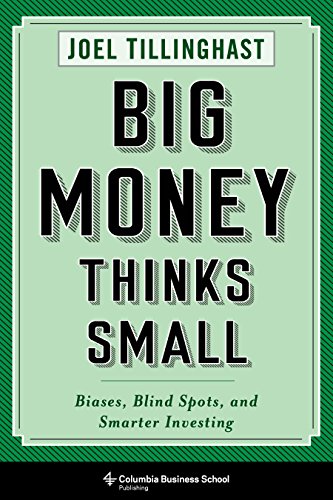
Book Review: Big Money Thinks Small

Big Money Thinks Small: Biases, Blind Spots, and Smarter Investing (Columbia Business School Publishing) by [Tillinghast, Joel]

https://www.amazon.com/Big-Money-Thinks-Small-Publishing-ebook/dp/B0743JNFBZ/ref=tmm_kin_swatch_0?_encoding=UTF8&qid=&sr=

An interesting read. In terms of concepts and philosophies, the reader will not find anything new that was not encountered before if one has been constantly reading up on the topic of investment.

The author ties together concepts of value investing augmented with experiences and practical applications of financial history and behavioural psychology. The main takeaway for me is his account of the travails of Dendreon and the dangers of investing in a "story." To summarise, Dendreon was a biotech which developed a treatment for cancer. The main bull story for Dendreon was that once FDA approval is obtained, earnings will rocket to the sky. The ending was that Dendreon did actually obtain FDA approval, and its share price went up tenfold, however sales were disappointing and the company eventually declared bankruptcy!

There are several stocks on the ASX in which investors are clearly enamoured with the "story", the most vivid example being Mesoblast.

The author also addressed the issues inherent in indexing, factor investing and macro investing.

The only gripe I have with the book is that it could be better organised. The way it was written looks more like a stream of thought cobbled together hastily without any overarching framework.

A reminder that there is a library of my reading here.

Enjoy and prosper
Yours One-Legged